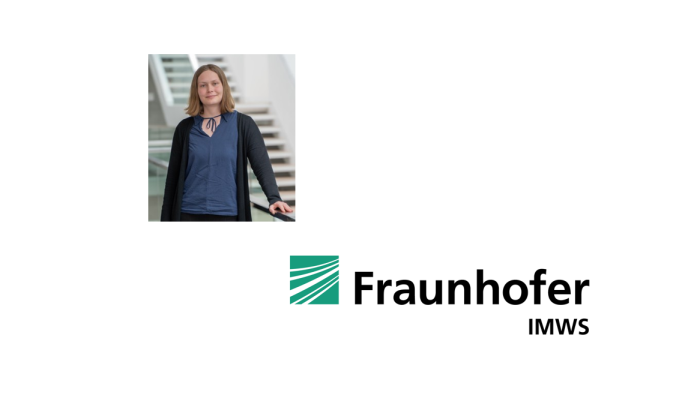
Annik Bernhardt has been a researcher on the topic of Material Diagnostics for H2 Applications at Fraunhofer IMWS since 2023. Her background is in chemistry with M.Sc. degrees from Leipzig University and Ohio University. Her doctoral research focuses on developing analytical methods for quality control and defect diagnostics in PEM electrolyzers. In UPeM these methods are applied to the PFAS-containing materials of the PEM in order to analyze how much and in which way they have degraded.
What was your original motivation to become a researcher/project manager?
In secondary school I was already interested in science, so I decided to study chemistry because it sits at the intersection of several scientific disciplines and this versatility was appealing to me. I enjoyed the scientific work I carried out during my studies; it is challenging but very rewarding to figure out a scientific problem and communicate the results. Becoming a full researcher followed naturally from this satisfaction.
What is your (main) research area today?
I am primarily concerned with developing analysis methods and workflows for materials used in electrolyzers and other energy applications. Notably, differentiating several degradation processes from one another and relating them to quality control parameters is a wide field. Multiple methods need to be combined in order to gain a full picture. For this I also further develop x-ray and optical spectroscopy methods.
What is the main focus of your team in UPeM?
In our team we are generally concerned with advanced material diagnostics and analytical work on materials and components used in water electrolysers and fuel cell systems. The activities in UPeM focus on developing and applying measurement and sampling approaches for PFAS detection. We perform detailed microstructural and chemical analyses of materials in different states of aging. By combining microscopy, spectroscopy, and mass spectrometric techniques, the work supports the identification of PFAS distribution, release pathways, and their correlation with material degradation. In addition, experimental testing and evaluation methods link laboratory-based investigations with operating conditions. Through this we contribute by validating measurement procedures and to a better understanding of emission sources, pathways and material behaviour.
Could you describe your favourite moment/satisfaction when working for the project and – more in general – for your organisation?
We have recently completed a first ex-situ degradation test to induce reference states for comparison to degraded industrial samples. While we were confident that we would be able to induce some effects into the samples, 800 h of testing is still a significant time investment. So, it was very satisfying to see that we have successfully induced measurable degradation into our materials. A long-term experiment working out is always a great success.
How do you expect UPeM results will affect your organisation and the clean hydrogen sector?
For the IMWS UPeM supports our aim of generating comprehensive insights into material performance and environmental interactions for reliable and sustainable hydrogen technologies. We are able to further develop our analytical methods and ex-situ degradation capabilities for PFAS-related materials within the project. For the clean hydrogen sector, I expect this project to provide guidance for operators and policy makers on sampling and analysis of PFAS releases and how to reduce them. The planned quantifications can give input into the risk assessment necessary for PEM electrolyzer and fuel cell operation.